Minneapolis Public Schools faces an almost $40 million budget gap this school year. When it comes to budget cuts, theater, art and music classes are often the first to go.
I protect every second I spend making art in my life. I savor every guitar chord I strum, every line I draw and every play I read. For me, creativity is the muscle that keeps my heart pounding. As a baby, I knew how to dance before I learned how to walk. School opportunities to nurture my love of art as I grew up made me the creative person I am today.
Theater teacher Ryan Underbakke was one of the reasons that I enrolled at Roosevelt High School in 2019. Theater was my passion, and I heard he was a second-year arts teacher like no other. It’s true. He changed my life in the short time he taught me.
But in my freshman year, despite the pleas from students and others who knew his value, the school let Underbakke go. This became my first real-life lesson in the public school system’s disinvestment in the arts.
During his first two months teaching at Roosevelt in 2018, Underbakke had an article written about him in the Longfellow Nokomis Messenger about his unique teaching style. He had put on an absurdist fall production about people turning into rhinos—an adaptation of Eugene Ionesco’s “Le Rhinoceros”—with student-written music.
“Why not empower students, treat them with respect, let them do their thing?” Underbakke said to the Messenger in 2018.
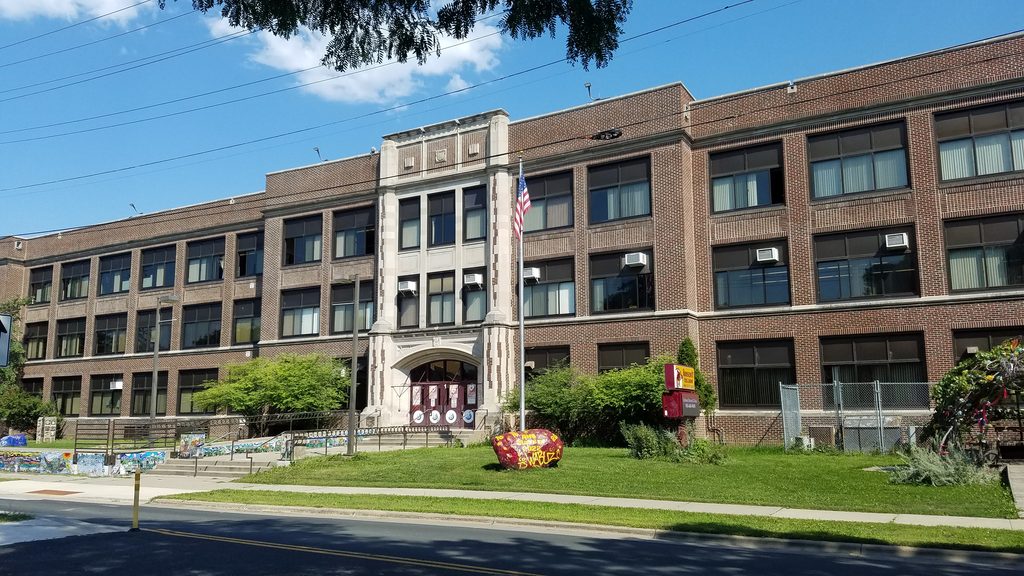
When I set foot inside Roosevelt’s 1920’s brick exterior, joining the hundreds of shoes kicking dust from the linoleum floors, he cast me in the 2019 fall production of Henrik Ibsen’s 19th century classic, “Peer Gynt.” A unique choice for high schoolers.
During rehearsal he encouraged me and my castmates to think outside of the box, directing us with absurdist ideas to navigate the theater department’s small budget. While Roosevelt didn’t have the resources to build a full set, the cast made walls and rooms with our bodies—and props, guns, and animals with our hands. When Underbakke absorbed our ideas, he gave us a hand in the show’s creation. It helped my theatrical passions flourish.
He began his class by asking every student how they were. Chin in hand, he listened to each of us in the circle, elbow on his knee, one leg folded over the other, in a pile on top of a blue plastic chair. He never let students get away with only saying “I’m good.” He wanted to hear what problems we dealt with, to give us respite from the high school slog. It made him the first teacher in my 14-year-old life to take me and my perspective seriously.
“Making students feel important is super important,” Underbakke said to the Messenger. “We don’t do it enough.”
But right after COVID-19 struck Roosevelt, Underbakke was let go. Despite my pleas to the school district, he was gone for good.
“[They’re] just failing to see where all of these other pieces come into play when you’re educating the whole child, and not just focusing on drilling reading, writing and math.”
Kearney Burns
The school district’s disruptions haven’t stopped since my freshman year of high school. In 2022, the district approved significant cuts to positions across schools — losing 12.8 positions in math, and 14.7 positions in social studies — but arts positions were still cut the most. The district lost 18.5 full time positions in the arts. This included South High School, which suffered significant cuts to their music, theater and dance programs that year. Their dance teacher, Nancy Nair, had her full-time hours cut almost in half.
On Sept. 15, the district announced it’s considering closing 16 schools in order to condense students in buildings with stronger resources. This followed the release of the district’s projected budget gap for this school year: $39.7 million.
While the school board decided Oct. 13 against closing any schools this school year, its budget problems still loom. Whatever the outcome, cutting arts programs isn’t the answer.
High school students who are involved in the arts are more likely to score higher on standardized tests, and even three times more likely to pursue a bachelor’s degree than students who aren’t involved in the arts, according to a 2019 study by the Minnesota Citizens for the Arts.
At South High School, two music teachers—Jonathan Edington and Sophia Butler—were nominated to be Minnesota’s 62nd Teacher of the Year this February. But Butler lost her job when her position was cut this summer. This fall, Butler started working as an orchestra teacher for Edina High School in the Edina Public School system instead.
Kearney Burns is a parent to a sophomore at Roosevelt High School, where she saw Roosevelt’s dance class and jewelry-making class cut. Last year at South she saw other creative courses cut too, like a senior-year English, social studies and art combination class she thought was valuable. And back in 2016, she watched former-performing-arts magnet Folwell Elementary lose much of its theater and dance classes while she worked there until 2019.
“[They’re] just failing to see where all of these other pieces come into play when you’re educating the whole child, and not just focusing on drilling reading, writing and math,” Burns said.
After Underbakke left Roosevelt in 2020, its theater department lost its balance. It took a few years after COVID to emerge again. I wonder how Roosevelt, and I, would have been different if he had stayed.