From my Black artist mentors, I’ve learned that art isn’t just about putting the pencil to the paper or using your imagination to create something from nothing.
From the first two years as an undergraduate at the University of Minnesota, I was a declared art major. I was mentored and inspired by lecturers in the department of art, especially with how still life paintings resemble “meaning” towards human life. For example, flowers have represented a form of still life in art history since the beginning of paintings.
There’s always been a deeper meaning behind paintings of flowers in still life. Most people perceive flowers as a metaphor for life. These things resonate with us because they resemble cycles of growth, transformation, and even death, which mirror the lives of human beings. “As we are only here for a short period of time going through different phases of life, flowers serve as a metaphor for our short lives, ” said Lamar Peterson, a professor of fine arts.
Peterson demonstrates this concept by combining his still life paintings with African American figures and flowers. He passes a deeper message along to the audience, for example, by showcasing his painting of a person looking relaxed among a meadow of flowers, which represents a state of tranquility and peace to students.
Before taking Peterson’s drawing and painting classes, I viewed art as a form of personal expression because behind every piece lies a unique story that holds some significant meaning. Some of Peterson’s paintings, like “Left Foot, Right Foot” and “Proud Gardener,” represent bright visual aesthetics that appeal to viewers.
It was only after taking his classes that I decided to shift my theme of art, from modern art to Black history as advocacy for social justice. Peterson was one lecturer who inspired me by painting because he blended his still life work with Black figures in art, and also because he lived about a mile away from where George Floyd was murdered in Minneapolis. He also had experience making Black abstract art, symbolizing life events in certain settings like gardens or streets. Upon studying Peterson’s work in the studio, I took away small character details through each piece.
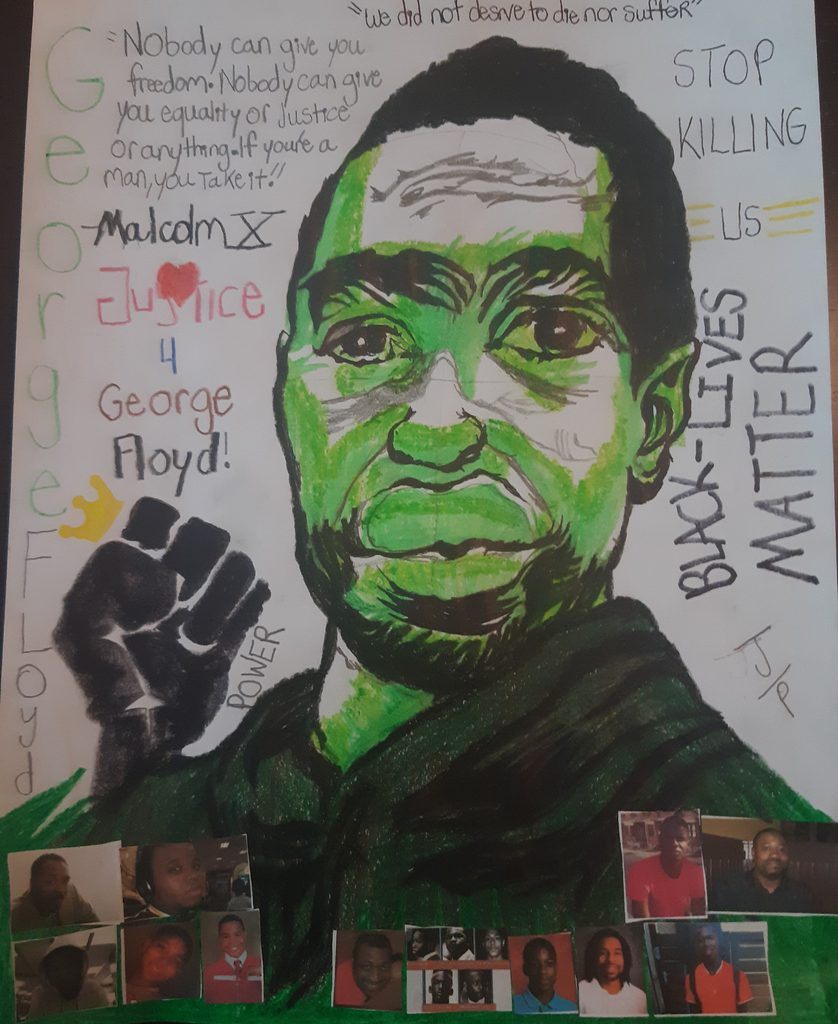
I later ended up creating an illustration of George Floyd representing power for the Black Lives Matter movement, which I displayed at the memorial site on Chicago Avenue. I also use social media like Instagram, where I occasionally post my artwork.
The illustration of George Floyd was meant to uplift Black voices and other minorities facing discrimination in and out of Minnesota. The fist is symbolic of the people’s fight for freedom.
I realized that publicly displaying your work helps you reach a larger audience seeking compelling narratives and powerful voices through social media. Instead of keeping your art hidden in a private gallery or stowed away in your sketchbook, you should share it with the world. Peterson’s painting techniques as well as his lectures gave me a new perspective from how I view contemporary art towards races. My transformation then began from starting off as a student artist in a studio and growing into an advocate for the media.
I’ve learned that art isn’t just about putting the pencil to the paper or using your imagination to create something from nothing. Art is about being expressive and sharing your ideas within cultural spaces. Many young people want to make an impact by working on a good cause for society, whether that’s to advocate for racial justice or world peace. Peterson showed me that dissemination of your art holds both beauty and voice, and social media allowed me to ensure that my voice was heard across the world.