As a person of color, I was initially silenced by fear during Operation Metro Surge, but community protest showed me how to speak out.
In early January 2026, Operation Metro Surge was already coming into Minneapolis at full force. But because I am a citizen, I did not think twice about the impact of my Latino features when I decided to come back to campus from winter break early to get more hours in at Student Unions & Activities.
That decision led to more than two weeks when I was alone in my apartment, missing three roommates who would provide connection in a terrifying situation.
Every morning, I would wake up and immediately go on my phone to see the damage that ICE was causing locally and statewide. Every day, this would create a pit in my stomach I couldn’t shake. I would sit in front of my 15th-floor apartment window for hours, looking below at University Avenue, expecting my worst thoughts and expectations to be suddenly realized in front of me. While these events would unfold around my neighborhood and town, I fortunately never had the experience of looking down and seeing ICE capture anyone or try to enter my complex.
I was scared to leave my apartment. Clearly, citizenship did not matter to ICE. Thus far, they have detained 506 U.S. citizens. In my eyes, they aimed to be trying to get rid of any person of color, which meant that I was a target to them.
A lot of Minnesota immigrants shared the same feelings that I was experiencing, stuck and waiting for it to end. While our lives were stopped and reduced to only leaving the house for necessities, ICE remained rampant across Minnesota.
Plenty of others, not people of color, have also suffered the actions and brutality of ICE agents. Renee Good, a 37-year-old mother and citizen, was fatally shot three times by ICE, unlawfully. The community came together and held a vigil for Good.
Alex Pretti, while recording ICE’s detainments, was eventually fatally shot by ICE as well, despite not displaying any threats of violence. No matter what anyone was doing, it seemed like it was ICE’s decision on whether to let a person leave the scene unscathed or to put a life in danger. And regardless of the decision, the administration would defend it. This alone encouraged me to stay inside.
During those two weeks alone, I would usually be on the phone with my boyfriend to keep comfort and sanity, but all of the conversations on my end would trail off into dread. In every phone call, we’d discuss the chances of ICE approaching me and what I could do.
The media I was consuming also did not help. I would only interact with the media about ICE operations, where ICE agents with an audience would capture someone, not caring about the legality of what they were doing. I would constantly refresh the local news, hoping to not see any updates about detainments or blatant racism.
From the time that Operation Metro Surge began, I did not go to a protest. I was scared that putting myself in that position as a person of color would just result in my capture. So for that time when I was alone in my apartment, I took my protests online, sharing information about current events regarding ICE, reposting content that brought their illegal actions to light.
The new semester started with everyone back on campus and immediately opposing ICE’s actions. There were protests at the Graduate, where students would sing, chant, riff their guitars, and anything else that would signify detestment towards ICE agents sleeping on campus.
On my way home, I’d pass the protesters with their painted and drawn signs, trying to avoid being seen by agents and officers. In my head, I felt like just being seen in my skin was enough to risk it all. A silent, agreeing protest in my head was enough for me at this point.
Afterward, I learned that some of those protesters were arrested. This reinforced my fear, as well as my silent activism.
On Jan. 26, a protest was started at the Home2 Suites, a couple blocks away from my complex. I could see its genesis from my window, from the same place I had spent my days wallowing in my anxiety.
But at this point, all of my roommates and friends and boyfriend were back in town. In a surge of confidence, I decided to go to the protest. I made my way, with my boyfriend following.
I don’t know whether it was the adrenaline rush going through me or the fact that there were multiple people there to hide behind. Either way, I was prepared for whatever protesting ICE actually entailed.
For a while, I stood off to the side, unsure of what to do. What was I able to get away with as a person of color without the risk of being unlawfully detained?
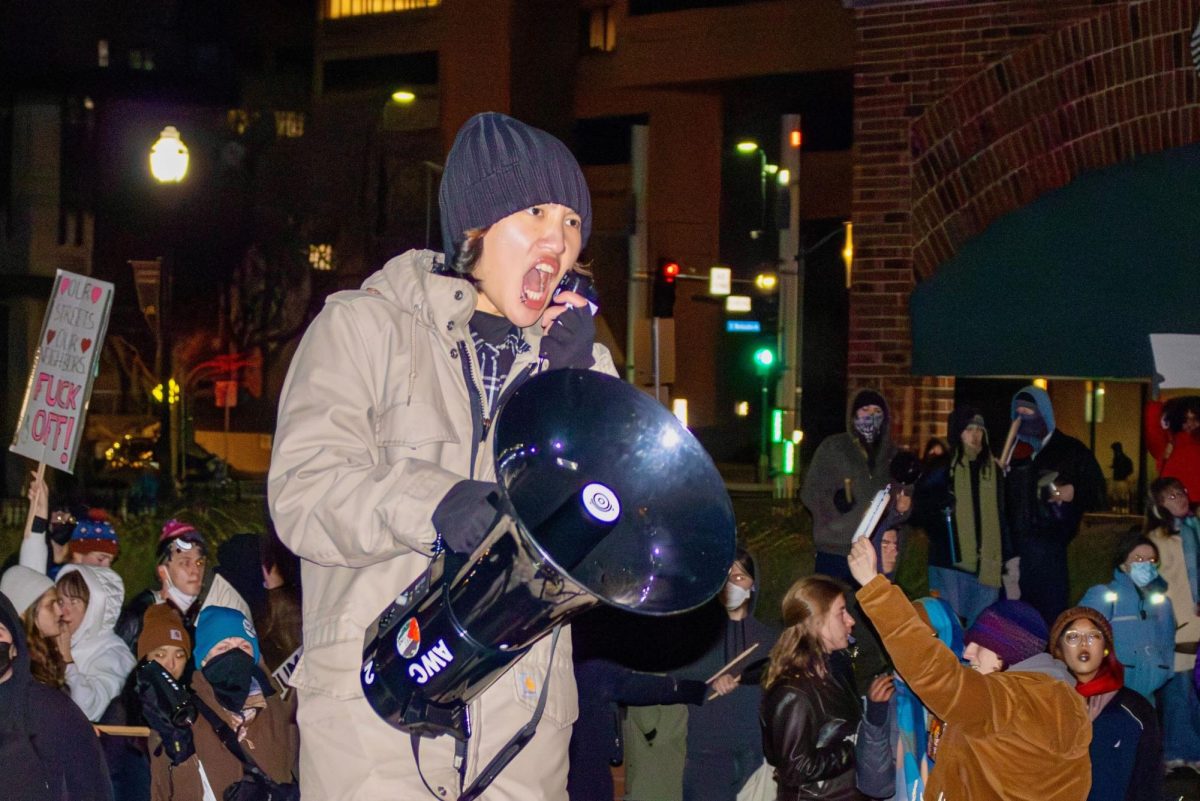
I came to find out that protestors are their own community. One protester advised me to cover my face to avoid being captured by cameras, saying: “It’s better to stay ready than to get ready.” I stepped into the middle of the street, blocked off with horizontal garbage cans and traffic cones, and banged on trashcans and participated in chants and cheers to keep the ICE agents awake in their hotel rooms.
When a window of the hotel was broken, I took that as my cue to leave before legal consequences followed.
I got back to my 15th-floor window, and watched as ICE agents and police officers arrived. I saw the entire process unfold before my eyes.
I watched as they detained a group of people, handcuffed them as they were kneeling on the street now flooded with armed vehicles, then eventually as they removed the handcuffs and told them to head home through the slightly distorted megaphone. Even in the detainment, the protestors were in a group.
This time, as I watched, I was not filled with an existential dread, but rather a sense of curiosity and pride that I saw them — a group I had been a part of — standing up for what’s right. My rights.